
On July 9 and 10, 2026, the Centre Polyvalent Saint Augustin (CPSA) in Lomé (Togo) hosted the inaugural training session for the EmmAdapté program, bringing together 11 participants from the project’s 10 specialized partner organizations—with the University of Lomé sending two representatives—in partnership with FETAPH and the Emmabuntüs Collective.
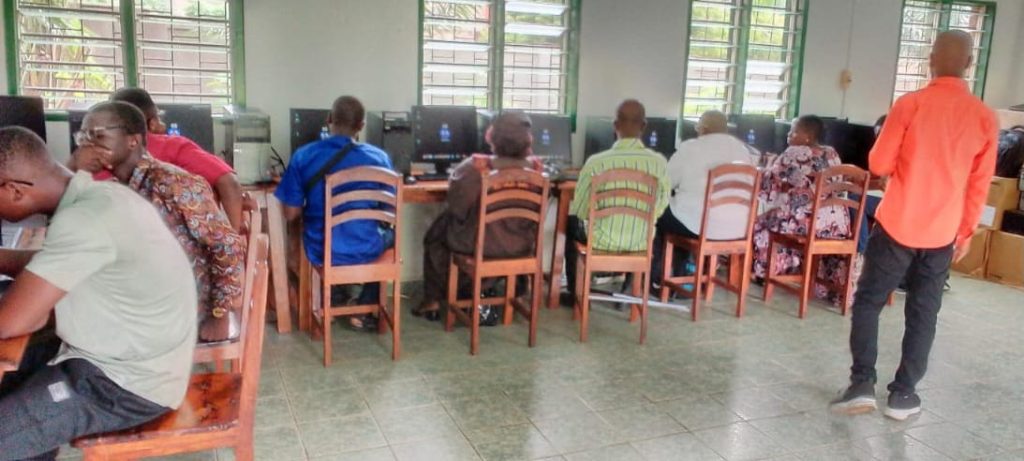
Over the course of two days, under the guidance of Mr. Têvi Akoeté LOGOVI (accessibility tools and visual impairment) and Mr. Elias AMAH (Linux operating system), participants learned about and practiced using the Emmabuntüs distribution—a free and open-source system specially adapted for people with visual impairments.
An ethical and strategic choice:
free software in service of the global South
Unlike commercial systems such as Microsoft Windows, Emmabuntüs is completely free and non-commercial. This is a significant advantage for organizations operating in resource-constrained countries: no license fees, no dependence on private software vendors, and no hidden costs. Free software thus puts technology at the service of those who need it most, without any financial strings attached. For specialized institutions in Togo—which are often under-equipped and underfunded—this represents a tangible and lasting freedom.
On the agenda: Linux, accessibility, and independence
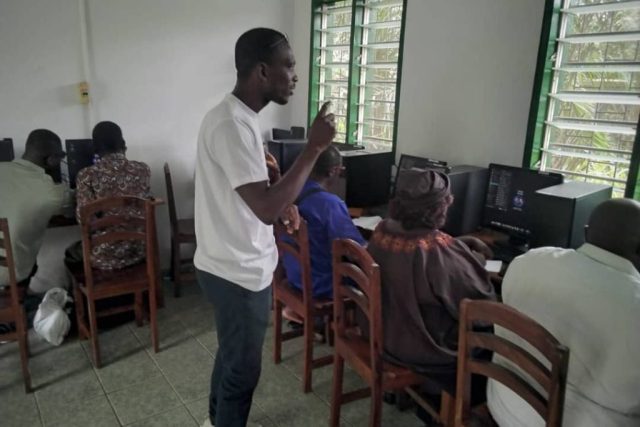
The first day laid the groundwork: an introduction to Linux and its free alternatives to common Windows tools (LibreOffice Writer, Calc, Impress), an introduction to the Kiwix software (offline encyclopedia), and an introduction to Emmabuntüs’ accessibility tools—notably the Orca screen reader and the text-to-speech engines eSpeak, Svox Pico, MBROLA, and Piper. The second day reinforced what had been learned: mastering the Caja desktop (designed specifically for the visually impaired), the Whisker menu, keyboard shortcuts, and volume control.
A thought-provoking exercise
One moment in particular left a lasting impression: participants without visual impairments were asked to use the keyboard without looking at the screen, to gain firsthand experience of the daily reality faced by users with visual impairments. This exercise was as much about empathy as it was about education, designed to enhance the quality of knowledge transfer within each organization.
Enriching exchanges
Mr. Emmanuel Aziakesse shared a highly appreciated tip: sharing a Wi-Fi connection from a cell phone to computers using the Net Share app—a practical solution for organizations with limited connectivity.
A symbolic computer handover ceremony
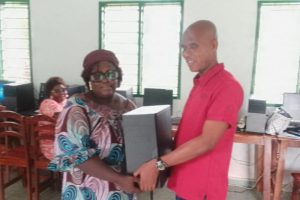
The training concluded with a highlight: Mr. LOGOVI presented each organizational representative with a complete computer setup (CPU, monitor, keyboard, mouse, and cables) in the presence of the two trainers—an immediate demonstration of YovoTogo’s commitment.
Goals Achieved, Momentum Gained
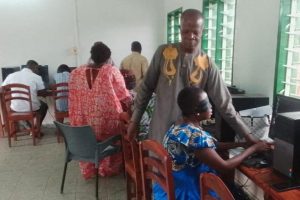
In his final report, the trainer, Mr. LOGOVI, confirms that the training objectives were fully met: participants have now mastered the fundamentals needed to install, set up, and use Emmabuntüs, and are ready to assist their own organizations in setting up appropriate computer labs. Advanced training sessions and technical support are already recommended to ensure these skills are maintained over the long term.
This article is based on the internship reports written by Ms. Arlette Chimène Lanlenou, Ms. Tchotcho Enyonam Kueve, Mr. Bayor Yassr (CIEFA), and Mr. Têvi Akoeté Logovi (trainer’s report).
Original article in French on the YovoTogo website
At the end of this training session, Ms. KUEVE and Mr. AZIAKESSE kindly agreed to answer trainer Jean-Pierre LOGOVI’s questions and share their impressions of the training.